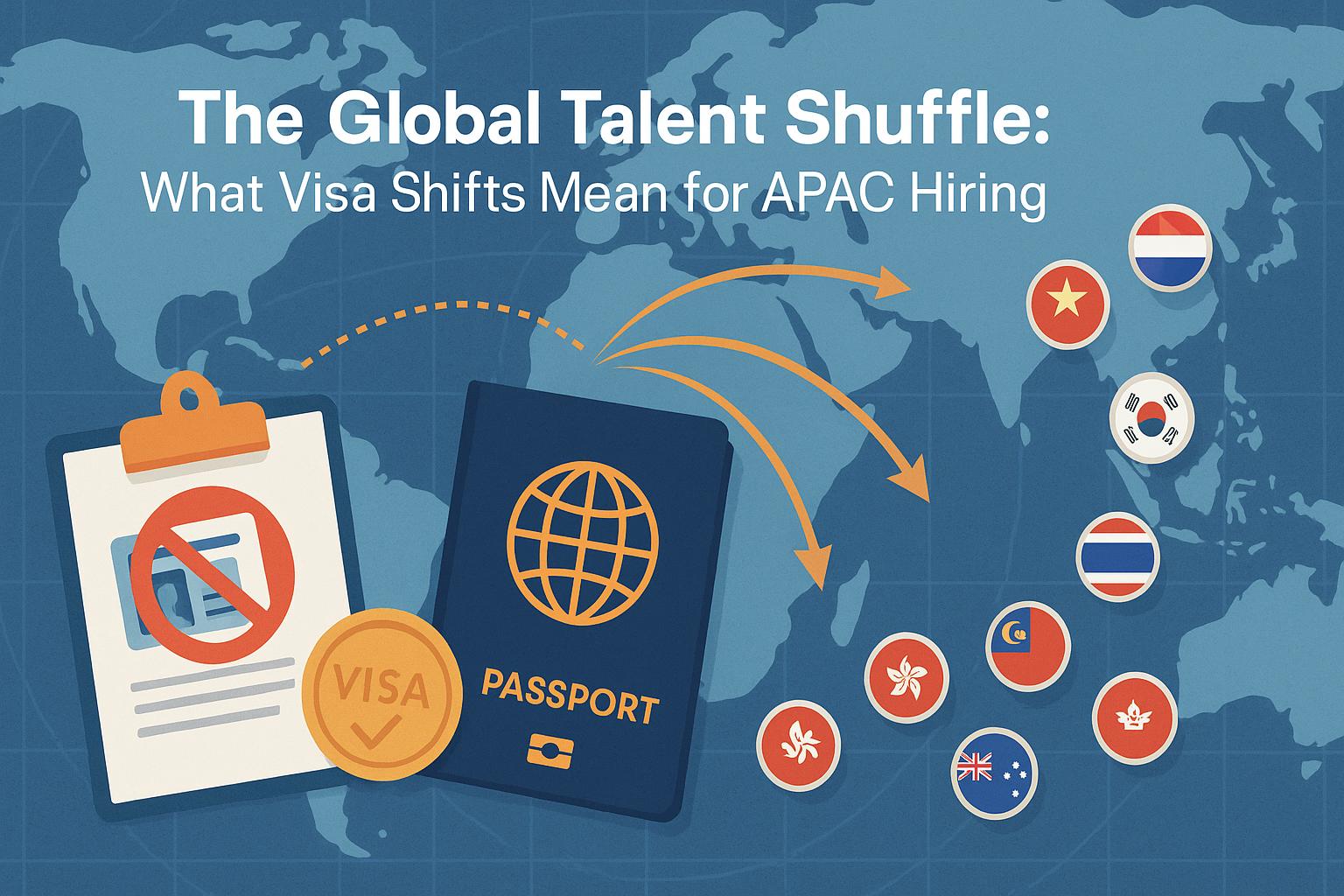
When one gate closes, another one creaks wide open. That’s the story of global talent mobility in 2025.
The U.S. just cranked up the cost of the H-1B visa to eye-watering levels (up to $100,000 per filing). For many companies, that price tag is less a policy tweak and more a giant “keep out” sign. The ripple effect? Skilled professionals are scanning the horizon, and Asia-Pacific is looking more like home turf than a stopover.
For APAC employers, this is both an opportunity and a wake-up call. The talent is available—but only to those who are ready to move quickly, design visa-friendly roles, and benchmark salaries realistically.
Where the Opportunities Are in APAC
1. Australia
- Migration Program 2025–26 is steady at 185,000 permanent places, with a heavy skilled focus.
- Employer sponsorship and the revamped Skills in Demand visa make it easier to target engineers, automation experts, and high-tech specialists.
2. Singapore
- The COMPASS framework has been refreshed for 2025, with updated shortage occupation lists and revised salary benchmarks.
- The Overseas Networks & Expertise (ONE) Pass remains a magnet for senior executives and rainmakers who need multi-employer flexibility.
3. China
- Launching on 1 October 2025, the new K Visa specifically targets young STEM talent—even allowing some to enter without a job offer. Beijing is betting big on pulling early-career engineers and AI researchers into its ecosystem.
4. South Korea
- The K-Tech Pass, launched last year, is ramping up to issue 1,000 visas by 2030. Think elite AI, semiconductors, and advanced manufacturing profiles.
5. Thailand
- Updates to the Long-Term Resident (LTR) Visa now make it easier for senior executives to anchor advanced manufacturing or regional leadership roles in Bangkok and beyond.
6. Indonesia
- The Golden Visa program, refined in 2024/2025, offers 5–10 year residency to investors and senior executives. Perfect for regional leadership seats.
7. Malaysia
- The DE Rantau Digital Nomad Pass has expanded to cover more roles beyond IT. This gives companies in Singapore or KL an edge in building cost-effective, remote-ready pods of engineers and analysts.
8. Hong Kong
- The Top Talent Pass Scheme saw enhancements this year, with longer validity and a wider university list. A solid magnet for biotech, finance, and commercial leaders.
9. New Zealand
Just announced (Sept 2025): Two new residency pathways for skilled workers and trades. With talent shortages biting, NZ is now directly competing for the same engineers and technicians targeted by Singapore and Australia.
What Employers Must Do Now
- Calibrate compensation. Salary benchmarks tied to visa approval are non-negotiable. Lowball offers are simply paperwork that goes nowhere.
- Design visa-friendly roles. Job titles and descriptions need to align with shortage occupation lists—whether it’s semiconductors, instrumentation, or process safety.
- Think multi-hub. Build a mix: leadership HQ in Singapore, cost-efficient pods in Malaysia/Thailand, specialist expertise in Australia, and long-stay executives in Indonesia.
Offer career scaffolding. China and Korea are pitching visas with built-in career runways. Your counter is clear leadership tracks, training budgets, and family support.
What This Means for Candidates
- Pivot from U.S. plans. If H-1B costs are out of reach, APAC visas offer faster, cheaper, and often more stable routes.
- Get documents airtight. Degree certificates, salary letters, and skills mapped to official shortage lists are the real ticket.
Think ecosystem, not just job. China and Korea are for STEM futures, Singapore and Hong Kong for leadership, Australia for residency pathways, and Malaysia/Thailand for remote-friendly setups.
The Big Picture
Global hiring has always been about supply and demand. But in 2025, it’s also about policy, paperwork, and price. The U.S. might be slamming the door shut, but APAC is opening windows, skylights, and side entrances.
The winners will be the employers who act now—with smart compensation strategies, visa-aligned job design, and relocation programs that feel human, not transactional. And the candidates who prepare today will find themselves not blocked, but accelerated.